
Starting in 2026, the CMA exam will introduce a new question format — and naturally, many candidates are wondering what that means for their chances of passing.
Whenever an exam changes, it can raise concerns about difficulty, preparation, and whether existing study plans still apply. The good news is that this update doesn’t mean that the CMA exam will be harder or that you’ll need to change what you’re required to learn.
Instead, this update addresses how your knowledge is evaluated.
I’ll walk you through what this shift means for your exam strategy, what stays the same, and how to prepare with confidence.
You can also download a free sample CBQ case to see how the new question format works in practice. Don’t miss it!
What Are the CMA Exam Changes in 2026?
In 2026, the CMA exam will undergo a major format update to align with global exam standards. The IMA will start using case-based questions to replace traditional essay questions.
This update is being rolled out gradually, giving you time to understand the new format and adapt accordingly.
CMA Essay Questions Are Being Replaced by Case-Based Questions
Historically, the CMA exam has included a mix of multiple-choice questions (MCQs) and essay questions for both Part One and Part Two. The essay section consists of two scenarios, each with 5-7 sub-questions. These questions test your ability to analyze information, perform calculations, prepare short reports, and clearly explain your logic and reasoning.
Beginning in 2026, the IMA will start to phase out essay questions and replace them with case-based questions (CBQs). Similar to the essay section, each CBQ will present a business case or scenario and will still require written responses.
CBQs are designed to assess your knowledge and decision-making in a more objective and structured way.
Timeline of Changes
It’s completely normal to feel a little nervous about a new exam format. The good news is that this transition will not happen all at once. Instead, the IMA is rolling out the CBQ format gradually throughout 2026, giving candidates time to adapt.
Here’s how the transition will work:
Timeline | Exam Format |
January/February 2026 | MCQs + Essay questions (No CBQs) *Registration for CBQs begins |
May/June 2026 |
Candidates can choose one of the following: MCQs + Essay questions MCQs + CBQs |
September/October 2026 and beyond | MCQs + CBQs (No more essay questions) |
If you plan to take the CMA exam in May/June 2026, you can sign up for the case-based version on the IMA website. If you’ve already taken Part One or Part Two with essays, you can still choose the CBQ option for the other part during the May/June 2026 window.
This phased rollout gives you flexibility. You can choose the traditional essay format if you plan to take the exam in the first half of 2026. But if you take it later, you’ll have plenty of time to understand and practice with the new format.
Starting in September/October 2026, essay questions will no longer be available in English-language CMA exams offered in the Americas, Europe, Asia-Pacific, the Middle East, and Africa.
China, Japan, and Taiwan will continue to use essay questions in both English and local-language CMA exams. If you take the exam in these countries, you won’t see any CBQs.
Any Other Changes?
Apart from the replacement of CMA essay questions with CBQs, everything else about the CMA exam remains unchanged. The syllabus, topics covered, and learning outcomes stay exactly the same. The MCQ section is not undergoing any format changes, and the scoring, exam duration, fees, difficulty level, and overall rigor of the exam remain consistent.
You may be wondering whether you’ll need to purchase new textbooks or study materials if you’ve already started preparing for the exam. The good news is that the IMA has noted there is no need to do so, and you can continue using the materials you already have.
In summary, the only real change is the format of the written section. You still need to master and apply the same knowledge and skills to pass. The main difference is how you present your written answers.
What Are the Case-Based Questions in the CMA Exam?
Case-based questions are a new type of written-response question that will appear on the CMA exam in 2026. Instead of traditional essays, you’ll answer short business cases.
Each case gives you the information you need, followed by related questions that test how well you can apply CMA concepts in real situations.
Format of the CBQ
Both Part One and Part Two of the CMA exam will have two CBQs each. Each CBQ includes a short case study of about 250 words, followed by up to seven related questions.
These practical application questions may appear in several formats, including:
- Drag-and-drop
- Fill-in-the-blank
- Select-from-a-list
- Numerical entry and calculation questions
Candidates can expect CBQs to test a wide range of applied skills within various business scenarios.
You may be required to perform calculations, interpret financial and operational data, and analyze realistic business situations using CMA concepts. CBQs may also ask you to compare options, identify the benefits or limitations of different approaches, recommend the most appropriate course of action, or sequence steps in the correct order.
CBQs are still written-response questions, but they are more structured than essays. With CBQs, the focus is on applying CMA knowledge accurately in real situations, not on memorization.
Topics CBQs Can Cover
Case-based questions can cover the same content areas that essay questions have traditionally tested.
Topics in Part One of the CMA exam include:
- External Financial Reporting Decisions
- Planning, Budgeting, and Forecasting
- Performance Management
- Cost Management
- Internal Controls
- Technology and Analytics
Topics in Part Two of the CMA exam include:
- Financial Statement Analysis
- Corporate Finance
- Business Decision Analysis
- Enterprise Risk Management
- Capital Investment Decisions
- Professional Ethics
In other words, no new material is being added. CBQs will simply test your knowledge of the same syllabus content.
How CBQs Differ from Essay Questions
There are important differences in how questions are presented and how responses are evaluated when comparing traditional CMA essay questions to CBQs.
Traditional CMA essay questions are mostly open-ended. You’re presented with a business scenario and asked to explain concepts, do calculations, prepare financial statements, or justify recommendations in your own words. Because of this, some candidates try to memorize a lot of information and write as much as possible, hoping for partial credit. These answers also rely on how well you organize and present your response.
CBQs are much more targeted and structured. You still work through realistic business scenarios, but instead of long explanations, each case is split into specific tasks. These might include calculations, drag-and-drop responses, selecting correct options, or short-answer questions. The focus is on accuracy and applying CMA concepts correctly.
CBQs don’t change what you’re tested on. They simply change how you demonstrate your knowledge. This better reflects real-world decision-making, where management accountants analyze data and identify the best course of action, instead of writing long answers.
Example Case-Based Questions
The IMA has released sample case-based questions to help candidates understand how this new format will work in practice.
Below, you can see what the new question interface and structure look like. These examples show how CBQs move away from long written responses and toward more structured tasks such as calculations, selection-based responses, and applied decision-making.
Enter this link to get access to the full sample case so you can work through this problem from start to finish.
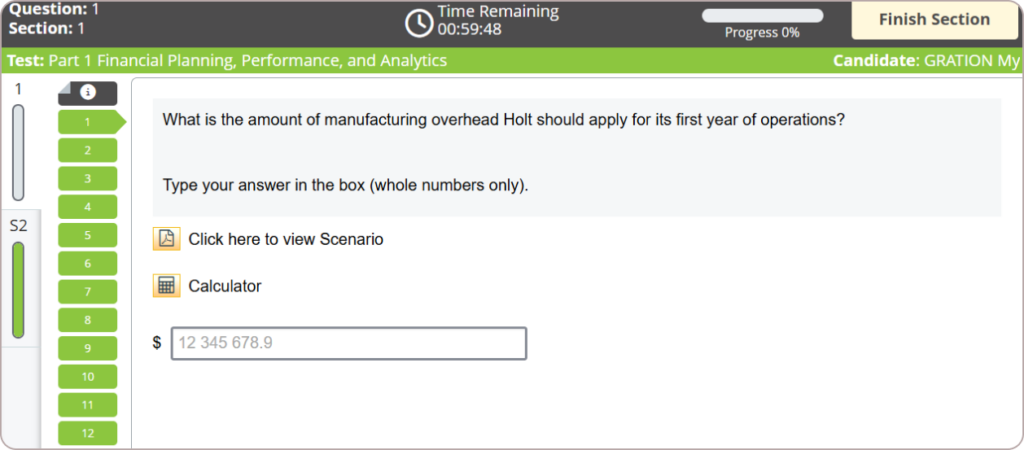
Numerical Entry
This type of question requires you to calculate a value and enter the correct answer directly. There are no multiple-choice options, so your accuracy depends on understanding the scenario and applying the right formula.
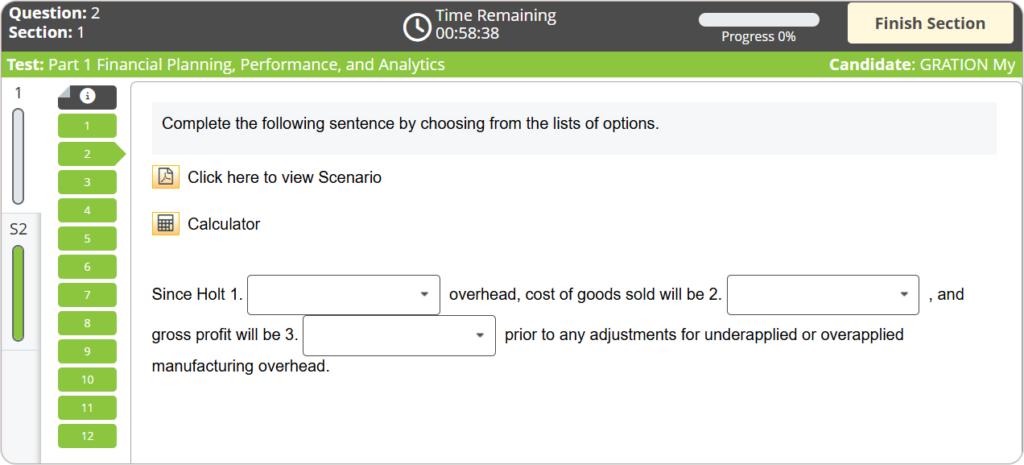
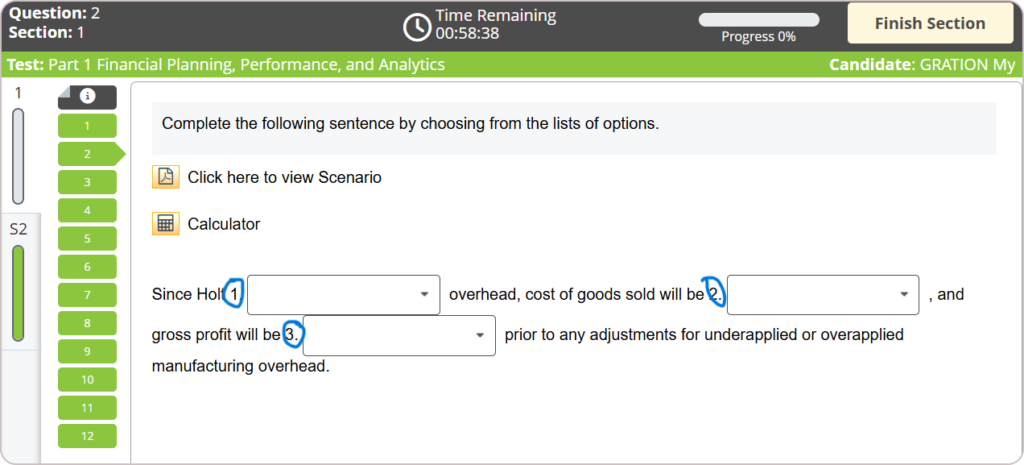
Drop-Down Selection
Here, you’ll complete a sentence or statement by selecting the most appropriate option from a list. These questions test conceptual understanding and your ability to interpret how decisions affect outcomes.
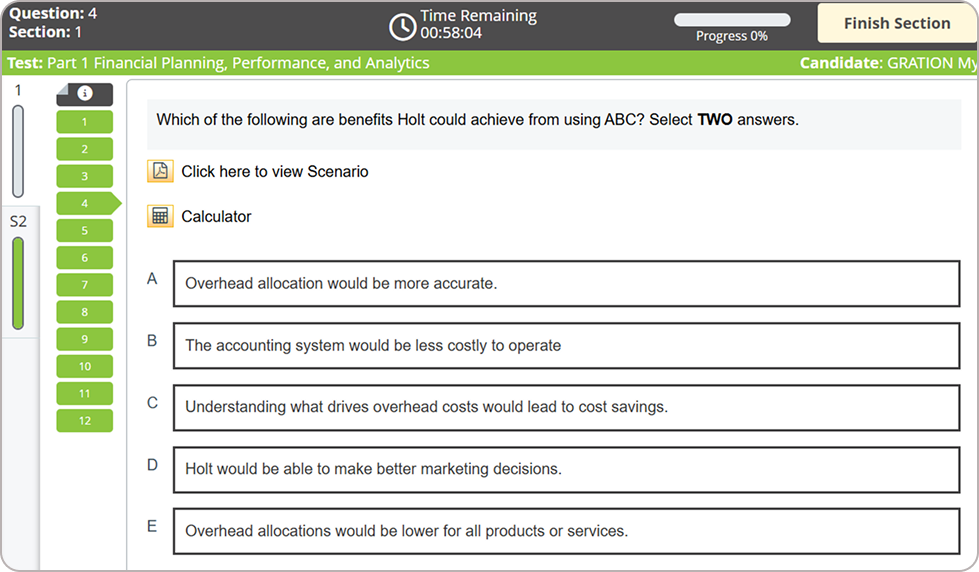
Multi-Select
In this format, you’ll choose more than one correct answer based on the scenario provided. You’ll need to evaluate multiple possibilities and identify which outcomes are actually supported by the data.
Sequenced Drop-Down
These questions require you to complete a series of linked selections in the correct order. They often test how changes in one decision affect another result.
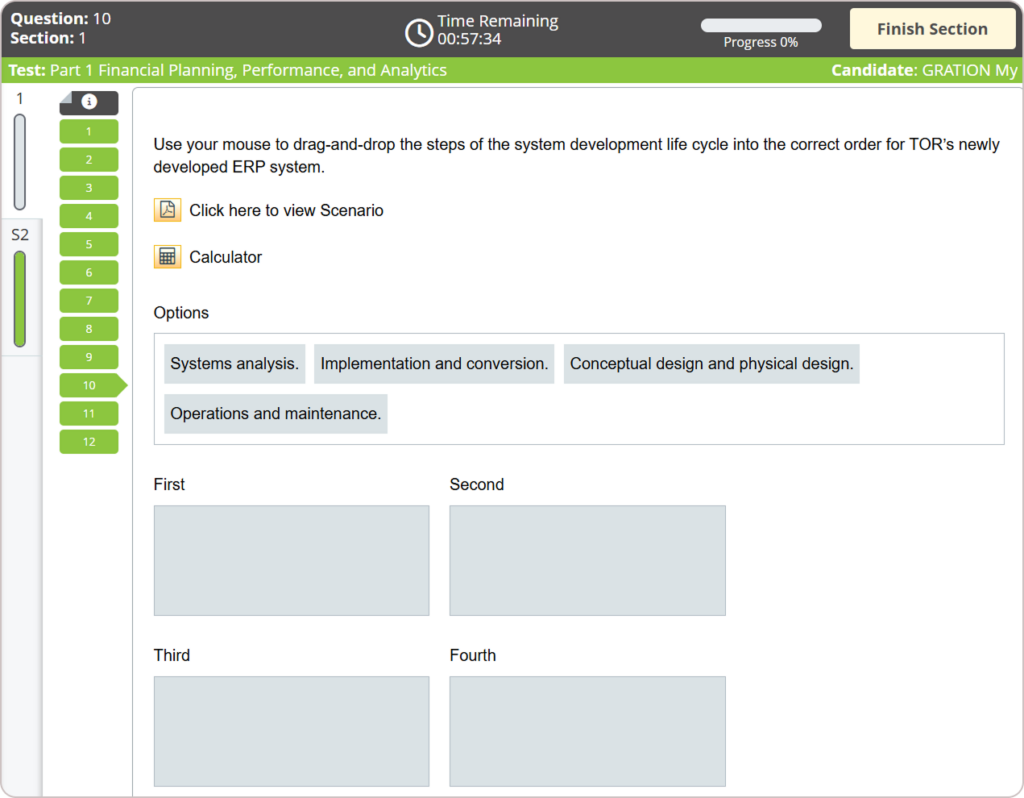
Drag-and-Drop
Drag-and-drop questions assess your ability to organize concepts logically. You might be asked to sequence steps, match stages, or align decisions with outcomes.
Enter this link to get access to the full sample case so you can work through this problem from start to finish.
This will give you a clearer sense of:
- How the case information is presented
- How questions are structured
- How you’ll be expected to apply CMA concepts in a real exam setting
Why the IMA Is Switching Essays to CBQs
The IMA mentions that this update is meant to improve how candidates’ skills and knowledge are evaluated. It won’t make the exam easier or harder, so the CMA exam pass rate is likely to stay about the same as before.
Below are the key reasons the IMA is introducing case-based questions.
Measure Skills More Consistently and Fairly
CBQs allow candidates’ responses to be assessed in a more standardized and objective way. Because everyone responds using the same formats — such as drag-and-drop tasks, numerical entries, or short structured responses — grading becomes more consistent and reliable across the board.
Maintain the Rigor and Global Standard of the CMA
The CMA is recognized worldwide, and the exam will keep its high standards. CBQs keep the exam rigorous by testing real-world decision-making and analytical skills. The content, difficulty, and learning outcomes stay the same. Only the way skills are measured is changing.
Align With Best Practices in High-Stakes Professional Exams
Many leading professional certification exams have already moved away from long essay responses in favor of case-based assessments. These formats offer greater reliability, consistency, and fairness. By introducing CBQs, the CMA exam stays aligned with modern testing best practices used in high-stakes professional exams worldwide.
Modernize the Exam Without Changing Its Value
The value and recognition of the CMA stay the same. CBQs just modernize the exam, putting more focus on analysis, judgment, and application of knowledge rather than memorization or long written answers.
How This Change Will Affect Students Preparing for the CMA Exam
It’s completely normal to wonder how this change might affect your exam prep, especially if you’ve already started studying for the CMA exam.
For most candidates, the impact will be minimal. You’ll still need to master the CMA syllabus, practice MCQs, and build a strong understanding of the core concepts. The main adjustment is how you prepare for the written section.
If you’re taking the CMA exam in May/June 2026 and beyond, your focus should shift toward applying concepts within short case scenarios. That means getting comfortable analyzing the information provided, focusing on true conceptual understanding rather than pure memorization, and accurately performing required calculations under time pressure. Reviewing CBQ samples released by the IMA and using updated CMA review courses can help you become familiar with the new format and expectations.
And because the IMA has confirmed there are no changes to the exam’s difficulty, length, or content, the amount of preparation time you need should remain the same.
Where to Find Help for CBQs
If you’re unsure how to prepare for case-based questions, you don’t have to navigate these changes on your own. The CMA Exam Academy review course has already been updated to reflect the 2026 exam format.
We will guide you step by step in applying CMA concepts to real business scenarios and practicing CBQs. You’ll have access to video and audio lessons, practice questions with model answers, and unlimited coaching support to help you feel confident for the CMA exam.
When you’re ready to focus on your CMA exam preparation, our 16-Week Accelerator Program gives you a clear plan, weekly coaching, and built-in accountability to keep you on track. You’ll have the support you need to ask questions, stay consistent, and prepare with confidence, all with one goal in mind: passing the CMA exam.
Backed by a 92% average pass rate and a pass-or-100% refund guarantee, our CMA review course helps you show up on exam day ready.
Have any more questions? Leave them in the comments below.

Hi, I’m Nathan Liao (aka the CMA Coach)! For the last 10 years, over 82,000 accounting and finance pros came knocking at my door seeking guidance and help. If you’re also aiming to conquer the CMA exam on your very first try—without wasting away time or money—you’ve found your ultimate guide. Dive in deeper to discover more about me and the dedicated team that powers CMA Exam Academy. Click here and let’s embark on this journey together!

6 Comments on “CMA Exam Changes in 2026: Introducing Case-Based Questions (CBQs)”
Please share sample CBQ exam for Part 1 and Part 2
Hi Jumel,
Since you are already studying with us, please contact us directly at [email protected], and we will be happy to help.
please can you share the sample case study based question for part 1
Hi Mamoon,
I recommend checking the IMA Official CBQ Page for the best examples:
https://www.imanet.org/cma-case-based-questions
Also keep in mind that while the format is changing to shorter, 250-word cases, the exam content and learning outcomes stay the same.
Good luck with your preparation!
please can you share the sample case study based question for part 1 and 2
Hi Dhaval,
Since you are already studying with us, please contact us directly at [email protected], and we will be happy to help.